SMARTERehab - Shoulder Girdle & Forearm: Movement & Loading Analysis for Motor Behavior Therapy
Shoulder girdle and forearm motor control: movement and loading analysis for motor behavior therapy. Sub-classification of movement pattern control and translation control, with specific neuromuscular retraining. Taught in English by Sean Gibbons (SMARTERehab). Cours donné en anglais.
Instructeur

Offert en cours privé
Cours donné par Sean Gibbons (SMARTERehab). Cours donné en anglais.
Horaire : 3 jours, du 18 au 20 septembre 2026, de 8h30 à 16h30.
Description du cours
Shoulder girdle and forearm symptoms can arise from trauma or exposure to loading, but frequently it is an insidious, recurrent and an ongoing problem for many people. This is often related to suboptimal loading on the tissues around the scapula-thoracic, glenohumeral joints and forearm.
The most popular loading mechanism to consider is biomechanical exposure to loading (or physical factors). This is where load exceeds the capacity of an anatomical area due to the force, speed, duration, or unusual positions it is used in. Often, combinations of these occur. However, there are two other important tissue loading mechanisms to consider. These are:
- Movement Pattern Control
- Translation Control of the joint
There is considerable individual variation in how these present. These loading mechanisms may present in combinations or alone. As well, how the central nervous system tries to control the loading is highly individual. The underlying hypothesis of movement as a link to musculoskeletal symptoms is that the way the central nervous system coordinates movement can influence tissue loading. A common example is the anterior movement of the glenohumeral joint during medial rotation.
In normal function we need the ability to vary postures and movement patterns, or kinetic chain sequence, in order to avoid tissue overload. It is normal and necessary to use our end range movements, however it is abnormal to continuously use the same movement pattern or end range movement. If the ability to vary the kinetic chain and control movement is lost, tissue load can be exceeded, tissue repair can become compromised and pathology may result.
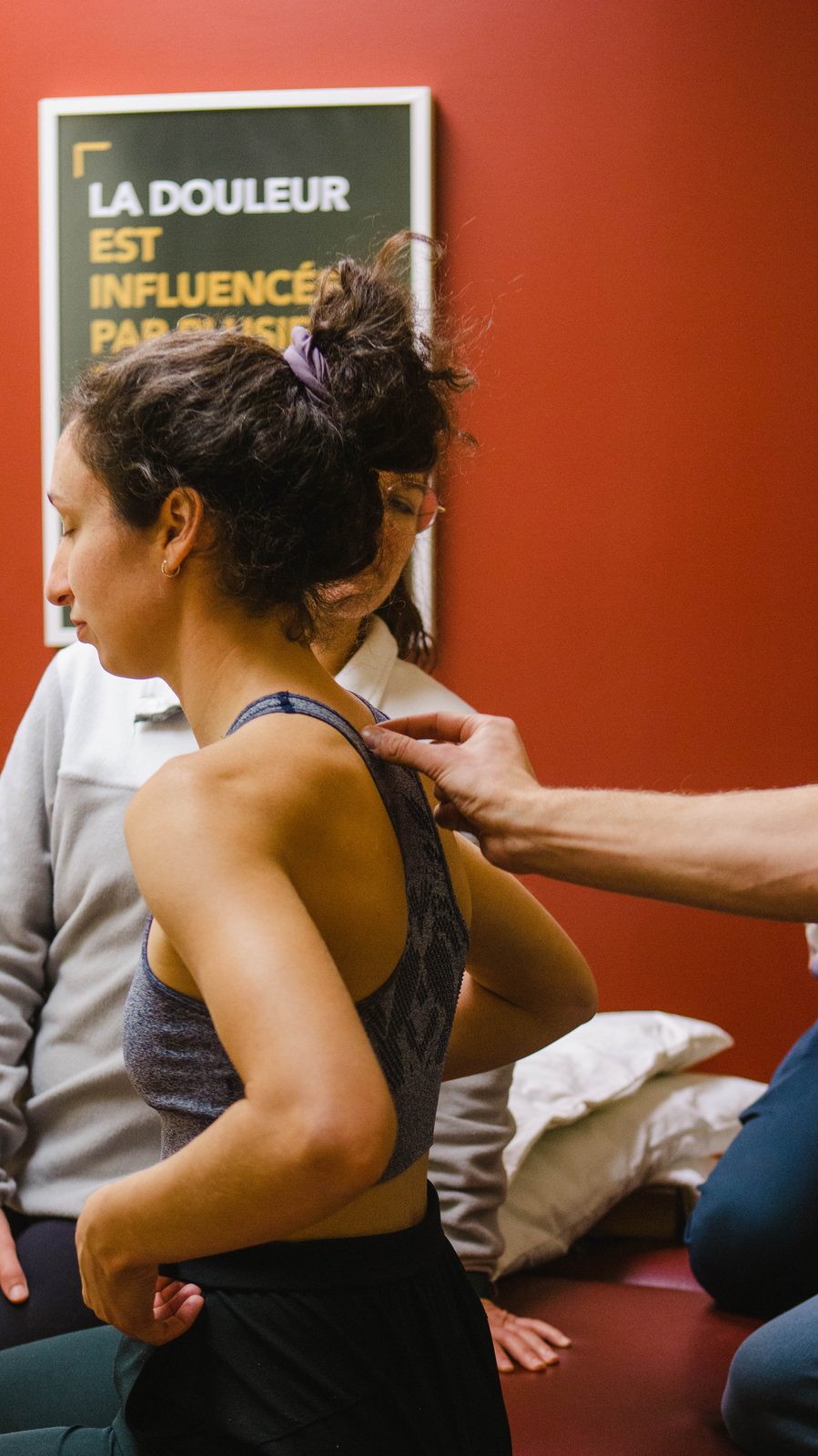
Alteration of muscle activation of the scapula-thoracic muscles can result in the scapula adopting a downwardly rotated resting position and / or a loss of dynamic control of the scapula in functional arm movements. This can cause tissue loading in the shoulder and cervical regions provoking the patient’s pathology. The glenohumeral joint frequently displays a dysfunctional pattern of excessive anterior translation, which is often combined with other neuromuscular deficits. This translation control deficit can contribute to tissue loading of local tendons and the glenohumeral joint. It is also a common neurodynamic interface. An anterior sitting humeral head also alters normal movement of the forearm and hand. This course involves a detailed assessment of the movement control patterns of the scapula-thoracic, glenohumeral joints and forearm.
Specific motor control retraining strategies will be introduced using a comprehensive and evidence based clinical reasoning process. This involves: specific activation of the appropriate stability muscles to control segmental translation of the glenohumeral joint, scapulothoracic, proximal and distal radioulnar joints, the carpus and the hand; the retraining of specific muscles to correct movement pattern control deficits; dynamic control of the scapula in functional movements; and the integration of these training strategies into a wider base of rehabilitation options. This can remove the tissue provocation and promote the normal healing process. Assessing and correcting scapula and glenohumeral movement can significantly improve post operative results as well. Some beneficial taping techniques will also be used. The exercise progressions are described and strategies for the integration into function are discussed with participant examples and case studies.
Objectifs spécifiques du cours
- Sub-classify movement pattern control and relate this to the client’s presentation.
- Distinguish shoulder pain between the scapula, glenohumeral joint and cervical spine with a movement pattern control assessment.
- Understand the relationship of scapular dysfunction to cervical dysfunction and glenohumeral dysfunction to forearm dysfunction.
- Use movement patterns as a clinical reasoning tool to help guide manual therapy and other techniques.
- Integrate the treatment of movement patterns and translation control into clinical practice.
What will you get from this course that you may not already have?
- Grasp Reflex (and other primitive reflexes that influence motor behavior around the shoulder girdle): The grasp primitive reflex is present in about 40% of the population. This contributes to increased muscle tone in the shoulder girdle and upper limb. We will show you how to treat it and how other primitive reflexes and sensory motor deficits are related to ongoing motor control deficits.
- Kinetic Medial Rotation Test: A newly validated test of shoulder girdle function (Morrisey, 2005). It differentiates between scapular and glenohumeral joint problems within the shoulder girdle. This helps give us a diagnosis and also lets us set priorities in rehabilitation.
- Upper Trapezius is a Good Guy Muscle: Upper trapezius does not elevate the scapula. It has a local and global stability role for the neck and shoulder girdle, with a major stability influence on the neck, shoulder and thoracic spine. It has an anticipatory timing pattern and is delayed with pain, similar to Transversus. It also experiences sudden atrophy, similar to Multifidus. It rarely loses extensibility so assessment and retraining needs to be specific. Lower trapezius does not pull the inferior angle of the scapula down and in. There are better ways to train lower trapezius for scapular stability.
- Anconeus, Supinator and Pronator Quadratus: These muscles have a translation control role in the forearm. We have developed specific exercises, analogous to multifidus in the lumbar spine.
- Wrist and Thumb Stability: Our detailed dissection has identified a mechanism to stabilize the wrist, thumb and individual joints of the fingers.
- Myofascial Trigger Point Release (MTPR): MTP release is a useful way in many people to improve aspects of motor behavior (e.g., range of movement). In some people it can be a source of pain. Motor Behavior Therapy can be used to help desensitize MTPs.
- Neurodynamics: Neurodynamic reactivity can significantly affect the way people move. We will show how movement can be used to treat neurodynamic reactivity.
- Taping: There are some great taping techniques for the shoulder girdle, forearm and neurodynamics.
Public cible
Physiotherapists.
Nous offrons des cours privés
Inscrivez-vous à un cours et transformez votre carrière en physiothérapie dès aujourd'hui.



Nos formateurs
Des formateurs passionnés qui guident chaque étudiant vers l'excellence clinique.

Sean Gibbons
Physiotherapist, research director and lecturer at SMARTERehab, internationally recognized for turning complex musculoskeletal pain into bite-size, evidence-based interventions.
Restez à jour avec les tendances et techniques de l’industrie
Rejoignez les professionnels qui transforment leur pratique clinique chaque jour.

FAQs
Trouvez les réponses aux questions qui vous préoccupent.
Prêt à transformer votre pratique?
Inscrivez-vous à un cours et transformez votre carrière en physiothérapie.